
Signs of Burnout: What to Look For and When to Get Help
Learn the signs of burnout, from exhaustion and cynicism to sleep problems, why it happens, how it differs from depression, and when to get help online in TX, AZ or WA.
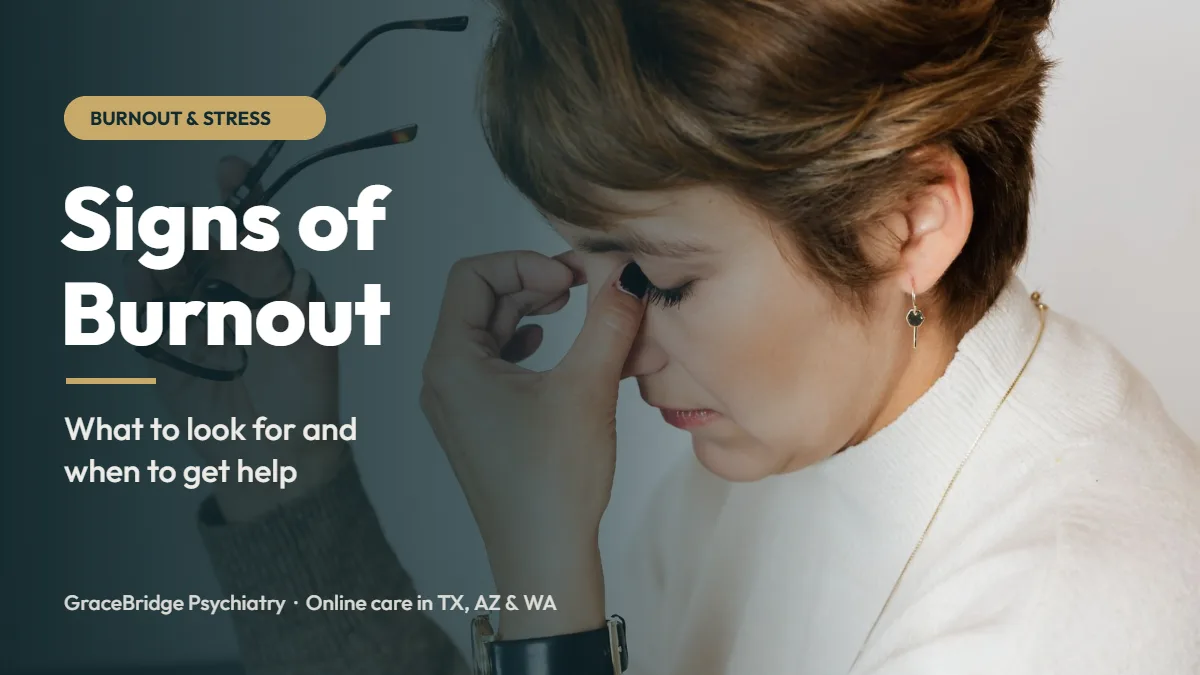
The most common signs of burnout are constant exhaustion that rest does not fix, growing cynicism or detachment from work, and a drop in performance. Other signs include headaches, poor sleep, irritability, brain fog, withdrawing from people and dreading each workday. If these last more than two weeks, it is time to get help.
Key takeaways
- The WHO defines burnout by three signs: exhaustion, cynicism and reduced effectiveness.
- Burnout builds slowly over months, so the early signs are easy to miss.
- Unlike normal tiredness, burnout does not go away after a weekend or vacation.
- Burnout often overlaps with depression, anxiety and insomnia, which are treatable.
- A psychiatric evaluation can sort out what you are dealing with and build a recovery plan.
You used to like your job. Now you set three alarms, drink a second coffee before 9 a.m., and still feel like you are moving through wet cement. You snap at people you love, your weekends disappear into recovery, and Sunday nights come with a knot in your stomach. If that sounds familiar, you may be noticing the signs of burnout.
Burnout is one of the fastest-rising mental health searches in the United States, and for good reason. In the American Psychological Association’s Work in America survey, 77% of workers reported work-related stress and 57% said it had caused negative effects such as burnout. In 2025, 54% said job insecurity alone was significantly raising their stress. This guide explains what burnout is, who gets it, why it happens, how it differs from depression, and exactly when and how to get help.
What is burnout?
Burnout is a state of physical, emotional and mental exhaustion caused by long-term stress that has not been successfully managed. The World Health Organization includes burnout in the International Classification of Diseases (ICD-11) as an occupational phenomenon. That means it is not classified as a mental illness by itself, but it is a recognized reason people seek health care.
According to the WHO, burnout has three defining dimensions:
- 1. ExhaustionFeeling drained of physical and emotional energy, with nothing left in the tank.
- 2. Mental distanceCynicism, negativity or detachment from your job and the people in it.
- 3. Reduced efficacyFeeling less capable and accomplishing less, even when you try harder.
Psychologist Herbert Freudenberger first described burnout in the 1970s in people working in helping professions. Today we know it can affect anyone in a demanding role, from software engineers and teachers to stay-at-home parents caring for young children or aging relatives.
Is burnout the same as stress?
Not quite. Stress usually feels like too much: too many demands, too much urgency, too much pressure. You are still engaged and often over-engaged. Burnout feels like not enough: not enough energy, not enough motivation, not enough care left to give. Stress can make you anxious and hyperactive; burnout tends to leave you empty, detached and hopeless about things improving.
15 signs of burnout to watch for
Burnout shows up in your body, your emotions and your behavior. You do not need all of these to be burned out. Notice how many you recognize and how long they have been going on.

- 01Physical
Exhaustion that sleep does not fix
You wake up tired, hit a wall by mid-afternoon and feel drained even on days off.
- 02Physical
Headaches and muscle tension
Tight shoulders, jaw clenching and tension headaches become part of every workday.
- 03Physical
Getting sick more often
Chronic stress weakens immune defenses, so colds and infections linger.
- 04Physical
Sleep problems
Racing thoughts at bedtime, waking at 3 a.m. thinking about work, or sleeping too much.
- 05Physical
Appetite and stomach changes
Skipping meals, stress eating, nausea, or digestive flare-ups.
- 06Emotional
Cynicism and detachment
You feel negative, sarcastic or numb about work and the people you serve.
- 07Emotional
Sense of failure and self-doubt
Even small tasks feel overwhelming and you question whether you are good at your job.
- 08Emotional
Loss of motivation
Things you used to care about now feel pointless. Mondays bring real dread.
- 09Emotional
Irritability
Shorter fuse with coworkers, partners and kids; small problems feel huge.
- 10Emotional
Feeling trapped
A persistent sense that nothing will change and there is no way out.
- 11Behavioral
Withdrawing from people
Avoiding coworkers, skipping social plans, eating lunch alone.
- 12Behavioral
Procrastination
Taking longer to finish tasks, starting work later, missing deadlines.
- 13Behavioral
Trouble concentrating
Brain fog, forgetfulness and rereading the same email three times.
- 14Behavioral
Coping with substances
Using alcohol, cannabis, food or scrolling to numb out or unwind.
- 15Behavioral
Reduced performance
More mistakes and less output, despite working the same or longer hours.
If several of these have lasted for weeks and are affecting your work, relationships or health, they are worth taking seriously. Many of them also overlap with depression, anxiety disorders and insomnia, which is why a professional evaluation matters.
The stages of burnout
Burnout rarely arrives overnight. Clinicians and researchers often describe it as a progression. Models differ, and not everyone moves through every stage, but this common five-stage picture helps people see where they are:
- 1. HoneymoonHigh energy and commitment. You say yes to everything.
- 2. Onset of stressSome days feel harder. Sleep and self-care start to slip.
- 3. Chronic stressPersistent fatigue, irritability, procrastination and more caffeine.
- 4. BurnoutExhaustion, cynicism, physical symptoms and self-doubt take over.
- 5. Habitual burnoutSymptoms become your normal and may tip into depression.
The earlier you act, the faster recovery tends to be. Catching burnout at stage two or three often means small changes are enough. At stages four and five, most people need structured support.
Who is most at risk?
Anyone can burn out, but some people and roles carry more risk:

- Healthcare workers and nurses, who face long shifts, emotional strain and staffing shortages.
- Teachers and school staff, balancing large classes, behavior challenges and limited resources.
- Caregivers of children with special needs, aging parents or chronically ill partners.
- First responders, social workers and therapists, who absorb other people’s crises.
- Managers and high achievers who struggle to delegate or set limits.
- Parents of young children, especially when also working full time.
- Students facing academic pressure, debt and uncertain futures.
- Adults with ADHD, who often spend extra energy compensating for focus and organization challenges.
- Remote workers whose work and home lives blur together with no clear off switch.
Personality also plays a role. Perfectionism, people-pleasing and a strong need for control all raise the risk, because they make it harder to stop, say no or ask for help.
Why burnout happens
Burnout is not a personal weakness. Research led by psychologists Christina Maslach and Michael Leiter points to six workplace mismatches that drive it:
| Driver | What it looks like |
|---|---|
| Workload | Too much work, too little time, constant urgency and no recovery periods. |
| Lack of control | Little say over your schedule, priorities or how you do your job. |
| Insufficient reward | Low pay, little recognition or no sense that your effort matters. |
| Breakdown of community | Conflict, isolation or lack of support from coworkers and managers. |
| Absence of fairness | Favoritism, unequal workloads or unclear and shifting expectations. |
| Values conflict | Being asked to do work that clashes with what you believe is right. |
Outside work, poor sleep, financial stress, caregiving duties, lack of social support and untreated conditions such as anxiety, depression or ADHD all lower your resilience and make burnout more likely.
What happens in your body
When stress is constant, your body keeps releasing stress hormones such as cortisol and adrenaline. Over time this can disrupt sleep, appetite, digestion and immune function, and it makes it harder for the brain to focus, remember and regulate emotions. That is why burnout feels both physical and mental.
When burnout starts and how long it lasts
Burnout usually develops over months or even years of chronic stress. Common turning points include a new role or promotion, a staffing cut, a new baby, caring for a sick relative, or a long stretch without real time off.
How long it lasts depends on how deep it goes and whether the causes change. Mild burnout may improve within a few weeks of rest and boundary changes. Moderate or severe burnout often takes three to twelve months, and recovery is faster when co-occurring anxiety, depression or sleep problems are treated at the same time.
A useful rule of thumb: if your symptoms have lasted longer than two weeks, or if a vacation did not help, it is time to talk to a professional.
Burnout vs stress vs depression
These three are easy to confuse, but the differences matter for treatment:
| Stress | Burnout | Depression | |
|---|---|---|---|
| Main feeling | Pressure, urgency, over-engagement | Emptiness, detachment, exhaustion | Persistent sadness, hopelessness, loss of interest |
| Scope | Tied to specific demands | Mainly tied to work or caregiving | Affects every area of life |
| Rest helps? | Usually, quickly | Temporarily, then symptoms return | Often not |
| Self-worth | Mostly intact | Feeling ineffective at work | Guilt and worthlessness, often broad |
| Medical status | Normal response | Occupational phenomenon (WHO) | Diagnosable medical condition |
| Best next step | Stress management | Change the causes, rest, support | Psychiatric evaluation and treatment |
Here is the catch: burnout that is left alone can turn into depression, and depression can make work feel impossible, which looks like burnout. If you are unsure which you are dealing with, that is exactly what an evaluation is for.
Quick burnout self-check
Answer these 10 questions based on the past month. This is an educational tool, not a diagnosis, but it can help you decide whether to talk to someone.
How to recover from burnout
Recovery is not about pushing harder. It is about removing what is draining you and rebuilding what restores you. These steps work best together:

Name it and track it
Write down your symptoms, when they started and what makes them better or worse. Patterns often reveal the biggest drains.
Protect your sleep first
Keep a consistent wake time, cut caffeine after noon, and put screens away an hour before bed. Sleep is the foundation every other step depends on.
Set real boundaries
Define a clear end to your workday, turn off notifications after hours and practice saying no to non-essential requests.
Talk to your manager
Ask to reprioritize projects, delegate tasks or adjust deadlines. Come with specific proposals rather than general complaints.
Take genuine time off
Use paid time off, and if you need longer leave, a clinician can help with documentation under FMLA or your employer’s policy.
Move your body and get outside
Even a 20-minute daily walk lowers stress hormones and improves mood and sleep.
Reconnect with people
Isolation feeds burnout. Schedule time with friends or family who leave you feeling better, not more drained.
Get professional support
Therapy such as cognitive behavioral therapy (CBT) can help you change thought patterns and build coping skills. A psychiatric provider can check for and treat depression, anxiety, ADHD or insomnia that may be keeping you stuck.
When to get professional help
Self-care helps, but it is not always enough. Reach out to a mental health professional if:

- Your symptoms have lasted longer than two weeks.
- Time off or a vacation did not make a difference.
- You are struggling to function at work, at home or in relationships.
- You feel hopeless, worthless or numb most of the day.
- You are relying on alcohol, cannabis or other substances to cope.
- You have panic attacks, constant worry or cannot sleep.
- Friends or family have told you they are worried about you.
How GraceBridge Psychiatry can help
At GraceBridge Psychiatry, we see adults across Texas, Arizona and Washington through secure telepsychiatry visits, so you can get care without leaving home or taking half a day off work. Your first visit is a comprehensive psychiatric evaluation that looks at your symptoms, sleep, stress, health history and goals. From there we create a personalized treatment plan, which may include therapy referrals, lifestyle and sleep strategies and, when a condition like depression or anxiety is present, medication management. We can also help with work-leave documentation when appropriate. See our accepted insurance plans and self-pay pricing.
Frequently asked questions
What are the first signs of burnout?
The earliest signs of burnout are usually subtle: feeling tired even after a full night of sleep, dreading Sunday evenings, needing more caffeine to get through the day, becoming irritable over small things, and losing the satisfaction you used to get from work you are good at. Many people also notice they are procrastinating more and pulling back from coworkers.
What are the 3 main signs of burnout?
The World Health Organization describes burnout through three core dimensions: (1) energy depletion or exhaustion, (2) increased mental distance from your job, or feelings of negativism or cynicism about it, and (3) reduced professional efficacy, meaning you feel less effective and accomplish less. Most other symptoms fit under one of these three.
How do I know if I am burned out or just tired?
Ordinary tiredness improves with rest, a good weekend, or a vacation. Burnout does not. If you return from time off and feel the same dread and depletion within a day or two, if you feel detached or cynical about work you once cared about, and if your performance is slipping despite effort, that pattern points to burnout rather than simple fatigue.
What does burnout feel like physically?
Burnout often shows up in the body before people recognize it emotionally. Common physical signs include constant fatigue, tension headaches, muscle aches, stomach or digestive problems, getting sick more often, changes in appetite, and trouble falling or staying asleep. Because these overlap with medical conditions, it is worth getting a checkup to rule out other causes such as thyroid problems or anemia.
What are the emotional signs of burnout?
Emotional signs include feeling drained or numb, a sense of failure or self-doubt, feeling trapped or defeated, increasing cynicism, loss of motivation, irritability, and feeling detached from people you care about. Many people describe it as running on empty, with nothing left to give.
Can burnout cause depression or anxiety?
Burnout and depression are different, but they overlap and can feed each other. Research shows that people with ongoing burnout are at higher risk of developing depression and anxiety disorders. If low mood, hopelessness, or loss of interest spreads beyond work to every part of your life, it is important to be evaluated for depression.
What is the difference between burnout and depression?
Burnout is tied mainly to chronic work or caregiving stress, and symptoms often ease when you are away from that stressor. Depression is a medical condition that affects every area of life, including hobbies, relationships and self-worth, and it does not lift with a vacation. Depression can also involve guilt, hopelessness and thoughts of death. A psychiatric evaluation can tell the two apart.
How long does it take to recover from burnout?
Recovery time depends on how long the burnout built up and whether the causes change. Mild burnout may improve within a few weeks of real rest and boundary changes. Moderate to severe burnout often takes several months, and some studies follow people for a year or longer. Getting professional support and treating any co-occurring anxiety, depression or sleep problems usually shortens recovery.
Can burnout make you physically sick?
Yes. Long-term stress keeps stress hormones like cortisol elevated, which can weaken immune response, disrupt sleep, raise blood pressure and worsen digestive issues. People with burnout often report more colds, headaches and stomach problems. Chronic burnout has also been linked to a higher risk of heart disease and type 2 diabetes in research studies.
Is burnout a medical diagnosis?
Burnout is not classified as a medical condition or mental disorder. In the ICD-11, the WHO lists it as an occupational phenomenon, a factor that influences health and a reason people contact health services. A clinician can still evaluate and treat the anxiety, depression, insomnia or other conditions that often come with it.
Who is most at risk for burnout?
Healthcare workers and nurses, teachers, caregivers, first responders, social workers, lawyers, managers, parents of young children and students are at higher risk. People with high workloads, little control over their schedule, unclear expectations, little recognition, or a mismatch between their values and their job are especially vulnerable. Adults with ADHD and perfectionists also burn out more often.
Can you have burnout without a job?
The WHO definition of burnout refers specifically to work, but people use the word to describe similar exhaustion from caregiving, parenting, school and even relationships. Caregiver burnout, parental burnout and academic burnout are widely studied. The signs and the path to recovery are very similar.
How do I tell my boss I am burned out?
Keep it factual and solution-focused. Explain that your workload has been unsustainable, give one or two concrete examples, and propose specific changes such as reprioritizing projects, delegating tasks, adjusting deadlines or taking time off. You do not have to share medical details. If you need formal leave or accommodations, a clinician can provide documentation.
Can a psychiatrist help with burnout?
Yes. A psychiatric provider can confirm whether you are dealing with burnout alone or with depression, anxiety, ADHD or a sleep disorder, which changes the treatment plan. Care may include therapy referrals, sleep treatment, lifestyle changes and, when a diagnosable condition is present, medication. Providers can also help with work-leave documentation when appropriate.
When should I see a professional for burnout?
Reach out if your symptoms last more than two weeks, if rest and time off do not help, if you are struggling to function at work or at home, if you are using alcohol or other substances to cope, or if you feel hopeless. If you ever have thoughts of harming yourself, call or text 988 right away or go to the nearest emergency room.
Sources
- World Health Organization. Burn-out an “occupational phenomenon”: International Classification of Diseases.
- American Psychological Association. Work in America Survey (2023, 2025).
- Maslach C, Leiter MP. Understanding the burnout experience: recent research and its implications for psychiatry. World Psychiatry. 2016;15(2):103-111.
- Mayo Clinic. Job burnout: How to spot it and take action.
- 988 Suicide & Crisis Lifeline. 988lifeline.org.
One Response