
Psychiatrist Near Me: How to Get Seen This Week (Online in TX, AZ & WA)
Searching for a psychiatrist near me? Learn how to find a psychiatrist accepting new patients, what the first visit involves, costs, and how to be seen online this week in TX, AZ or WA.
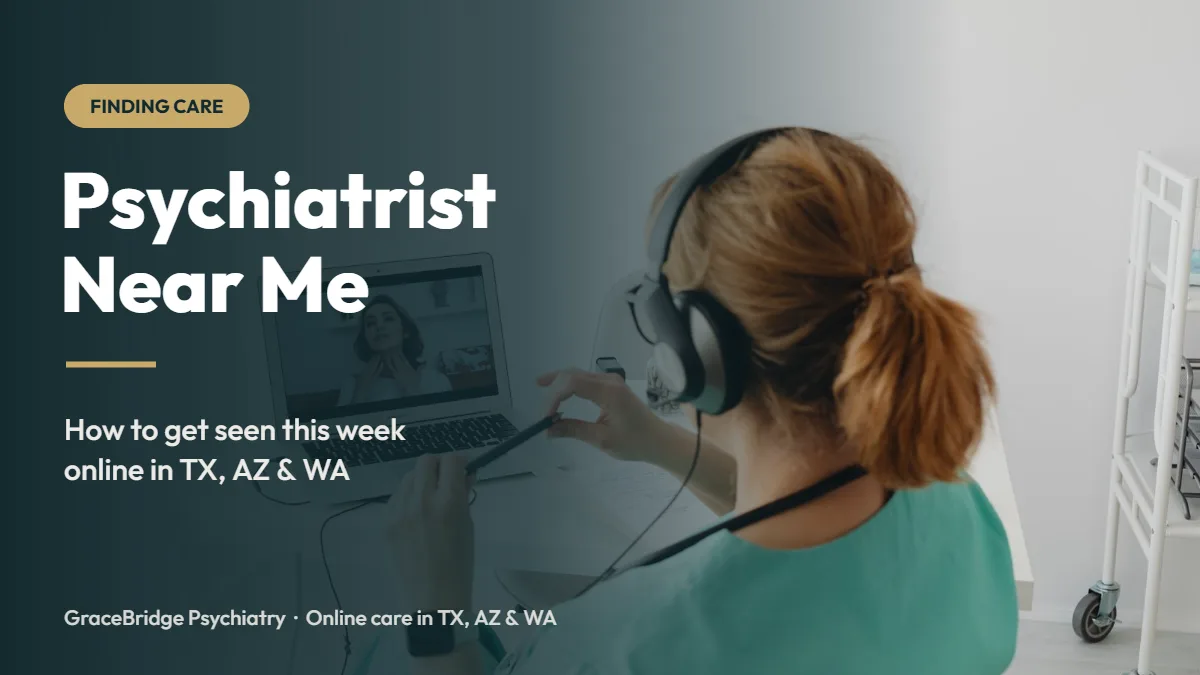
To find a psychiatrist near me fast, check your insurance directory, ask your primary care doctor for a referral, and look at telepsychiatry practices licensed in your state. Online psychiatrists often have openings within days rather than months. At GraceBridge Psychiatry, new patients in Texas, Arizona and Washington can usually be seen this week.
Key takeaways
- A psychiatrist or psychiatric nurse practitioner can diagnose mental health conditions and prescribe medication.
- Wait times for in-person psychiatry often run weeks to months; telepsychiatry is usually much faster.
- Online psychiatric care works as well as in-person care for most conditions, including depression, anxiety and ADHD.
- Check licensing (they must be licensed in your state), insurance, specialties and availability before booking.
- A free consultation call is the quickest way to find out if a practice is the right fit.
You finally decided to get help. You typed “psychiatrist near me” into Google, called three offices, and heard the same thing: we are not accepting new patients, or the next opening is in three months. That is frustrating, and it is also extremely common. The United States has a well-documented shortage of psychiatric providers, and more than half of U.S. counties have no practicing psychiatrist at all.
The good news is that the way people get psychiatric care has changed. You no longer have to limit yourself to offices within driving distance. This guide explains what a psychiatrist does, who should see one, how to find a psychiatrist near me accepting new patients, what happens at the first visit, how much it costs, and how to get seen online this week if you live in Texas, Arizona or Washington.
What does a psychiatrist do?
A psychiatrist is a medical doctor (MD or DO) who specializes in diagnosing and treating mental health conditions. Psychiatric mental health nurse practitioners (PMHNPs) are advanced practice nurses with graduate training in psychiatry who also evaluate, diagnose and prescribe. In Texas, Arizona and Washington, board-certified PMHNPs provide much of the country’s outpatient psychiatric care.
A psychiatric provider can:
- Complete a comprehensive psychiatric evaluation and make a diagnosis
- Prescribe and adjust medication through medication management
- Order lab work to rule out medical causes such as thyroid problems
- Create a personalized treatment plan that may combine medication, therapy and lifestyle changes
- Provide second opinions when treatment is not working
- Write documentation for work, school or disability when appropriate
Psychiatrist vs psychologist vs therapist
| Provider | Training | Can prescribe? | Best for |
|---|---|---|---|
| Psychiatrist (MD/DO) | Medical school plus psychiatry residency | Yes | Diagnosis, medication, complex conditions |
| Psychiatric NP (PMHNP) | Nursing degree plus graduate psychiatric training and board certification | Yes | Diagnosis, medication management, ongoing care |
| Psychologist (PhD/PsyD) | Doctorate in psychology | No (in most states) | Testing and psychotherapy |
| Therapist (LPC, LCSW, LMFT) | Master’s degree in counseling or social work | No | Talk therapy and coping skills |
Many people do best with both: a psychiatric provider for diagnosis and medication, and a therapist for weekly talk therapy.
Who should see a psychiatrist?
You do not need to be in crisis to see a psychiatric provider. Consider booking an evaluation if:

- You have felt down, anxious or on edge most days for two weeks or more
- Symptoms are affecting your work, school, relationships or sleep
- Therapy alone has not been enough
- You think you may have ADHD, bipolar disorder, OCD or PTSD
- You are having panic attacks or constant worry
- You are already on medication and it is not working or the side effects are hard to live with
- Your primary care doctor recommended a specialist
- You have had a big life change, such as a new baby, a loss or burnout, and you are not bouncing back
Psychiatric care is for adults of every background. If it would help you to work with a provider who understands your culture or identity, say so when you call. A good practice will take that seriously.
How to find a psychiatrist near me accepting new patients
Here is a step-by-step approach that gets most people an appointment fastest:
Decide in-person or online
If you are open to telepsychiatry, your options expand from a few local offices to every licensed provider in your state. That alone can cut wait times from months to days.
Check your insurance
Log in to your insurer’s website and search for in-network psychiatry or behavioral health providers. Call the number on the back of your card and ask for a list of providers accepting new patients. See the plans GraceBridge accepts.
Ask for referrals
Your primary care doctor, OB-GYN, therapist or employee assistance program (EAP) often know who has openings.
Confirm state licensing
Providers must be licensed in the state where you are located during the visit. GraceBridge providers are licensed in Texas, Arizona and Washington.
Look at specialties and fit
Check that they treat what you are dealing with, whether that is ADHD, postpartum depression, trauma or something else. Read reviews and look for a practice that explains its process clearly.
Ask the right questions on the phone
When is the first available new-patient appointment? How long is the first visit? Do you offer medication management? What does it cost if insurance does not cover it?
Book and prepare
Once you have a date, write down your symptoms, current medications, past treatments and questions so you get the most from the visit.
What makes a psychiatrist the “best” or “top” choice?
Rankings and star ratings only tell part of the story. The best psychiatrist for you is one who is licensed in your state, has experience with your concerns, can see you soon, listens without rushing, explains your options in plain language, and involves you in decisions. Fit matters as much as credentials.
Online psychiatrist vs in-person: which is better?
Research consistently shows that telepsychiatry produces outcomes comparable to in-person care for depression, anxiety, PTSD, ADHD and many other conditions. Patients often report higher satisfaction because there is no commute, no waiting room and fewer missed appointments.

| Online (telepsychiatry) | In-person | |
|---|---|---|
| Wait time | Often days | Often weeks to months |
| Travel | None, visit from home or work | Commute and parking |
| Privacy | No waiting room | Shared waiting room |
| Prescriptions | Sent electronically to your pharmacy | Sent electronically to your pharmacy |
| Best for | Most outpatient conditions and busy schedules | People who prefer face-to-face or need procedures |
Online care is not right for emergencies. If you are in immediate danger, call or text 988 or go to the nearest emergency room.
What happens at your first psychiatric appointment
The first visit is usually 45 to 75 minutes. Your provider will ask about:

- What brought you in and how long it has been going on
- Mood, anxiety, sleep, appetite, energy and concentration
- Past mental health history, treatments and medications
- Medical conditions and any medications or supplements you take
- Family history of mental health conditions
- Alcohol, cannabis and other substance use
- Work, relationships, stress and support
- Your goals for treatment
You may complete short questionnaires such as the PHQ-9 for depression or GAD-7 for anxiety. By the end, your provider will share their impressions, possible diagnoses and a plan. That plan might include medication, therapy referrals, lab work or lifestyle changes. You are always part of the decision.
Follow-up visits are shorter, often 20 to 30 minutes, and happen every few weeks at first, then less often once you are stable.
When to seek help and how quickly to act
Most mental health conditions respond better the earlier they are treated. As a rule of thumb, book an evaluation if symptoms have lasted more than two weeks or are getting in the way of daily life. Seek urgent help the same day if you are having thoughts of suicide or self-harm, hearing or seeing things others do not, are unable to care for yourself, or are using substances in a dangerous way.
Why finding a psychiatrist is so hard right now
It is not your imagination. Demand for mental health care has grown sharply, while the number of psychiatrists has not kept pace. Many psychiatrists are nearing retirement, many do not take insurance, and rural areas have very few providers. Psychiatric nurse practitioners and telehealth have become two of the main ways people now get timely care.
How much does a psychiatrist cost?
Costs depend on your insurance and the type of visit. With insurance, you typically pay your plan’s specialist copay or coinsurance after any deductible. Without insurance, an initial psychiatric evaluation often costs a few hundred dollars and follow-up medication visits cost less. GraceBridge lists transparent self-pay pricing and works with many insurance plans. Ask about costs on your free consultation call so there are no surprises.
How GraceBridge Psychiatry helps you get seen this week
GraceBridge Psychiatry is a telepsychiatry practice led by Tochi Nkwocha, MSN, PMHNP-BC, serving adults across Texas, Arizona and Washington. We treat depression, anxiety, ADHD, bipolar disorder, PTSD, OCD, panic disorder, insomnia and more. Here is how it works:
- Free consultation call: tell us what is going on and ask your questions.
- Book your evaluation: most new patients are seen within days.
- Meet online: join a secure video visit from home or work.
- Get your plan: leave with clear next steps, and prescriptions sent to your pharmacy when appropriate.
Read what patients say on our reviews page.
Frequently asked questions
How do I find a psychiatrist near me accepting new patients?
Search your insurance provider directory, ask your primary care doctor for a referral, and include telepsychiatry practices licensed in your state. Call and ask directly for the first available new-patient appointment. Online practices like GraceBridge often have openings within days for patients in Texas, Arizona and Washington.
Can I see a psychiatrist online?
Yes. Telepsychiatry is legal and widely used. The provider must be licensed in the state where you are located during the visit. You meet by secure video, and prescriptions are sent electronically to your pharmacy.
Is an online psychiatrist as good as in-person?
For most outpatient conditions, yes. Studies show telepsychiatry has outcomes comparable to in-person care for depression, anxiety, PTSD and ADHD, with high patient satisfaction and fewer missed appointments.
Do I need a referral to see a psychiatrist?
Many people do not. Some insurance plans, especially HMOs, require a referral from your primary care doctor. Check your plan or call your insurer. Self-pay patients never need a referral.
What is the difference between a psychiatrist and a psychiatric nurse practitioner?
A psychiatrist is a medical doctor with psychiatry residency training. A psychiatric mental health nurse practitioner (PMHNP) has graduate psychiatric training and board certification. Both can evaluate, diagnose and prescribe medication for mental health conditions.
How long does it take to get a psychiatrist appointment?
In-person wait times commonly range from a few weeks to several months, depending on location and insurance. Telepsychiatry practices often have new-patient openings within the same week.
What should I bring to my first psychiatrist appointment?
Bring a list of your symptoms and when they started, current medications and supplements with doses, past treatments that did or did not help, relevant medical history, family mental health history, your insurance card and a list of questions.
How much does it cost to see a psychiatrist without insurance?
A first psychiatric evaluation without insurance often costs a few hundred dollars, and follow-up visits cost less. Prices vary by practice, so ask for self-pay rates before booking. GraceBridge publishes its self-pay pricing online.
Can a psychiatrist prescribe medication online?
Yes, psychiatric providers can prescribe most medications through telehealth when clinically appropriate. Certain controlled medications have additional federal and state rules, which your provider will explain.
What conditions does a psychiatrist treat?
Psychiatric providers treat depression, anxiety disorders, panic disorder, ADHD, bipolar disorder, PTSD, OCD, insomnia, postpartum mood disorders, schizophrenia and other psychotic disorders, and more.
How do I know if I need a psychiatrist or a therapist?
If you think you may need medication, a diagnosis, or your symptoms are severe or not improving with therapy, start with a psychiatric provider. If you mainly want to talk through stress and build coping skills, a therapist is a good start. Many people benefit from both.
Will my psychiatrist talk to my therapist or primary care doctor?
Only with your written permission. Coordinating care often helps, so your provider may ask if you would like them to share information with your other clinicians.
Is what I tell a psychiatrist confidential?
Yes. Your information is protected by HIPAA and professional ethics. Exceptions are rare and include immediate risk of serious harm to yourself or others, or certain legal requirements, which your provider will explain.
How often will I see a psychiatrist?
Early in treatment, follow-ups are often every two to four weeks while medications are adjusted. Once you are stable, visits may be every one to three months.
What if I need help right now?
If you are having thoughts of harming yourself or feel unsafe, call or text 988, call 911, or go to the nearest emergency room. Outpatient psychiatry practices, including telepsychiatry, are not emergency services.
Sources
- Health Resources and Services Administration. Behavioral Health Workforce Projections
- American Psychiatric Association. What Is Telepsychiatry?
- Hilty DM, et al. The effectiveness of telemental health: a 2013 review. Telemedicine and e-Health. 2013;19(6):444-454.
- National Institute of Mental Health. Tips for Talking With a Health Care Provider About Your Mental Health
- 988 Suicide & Crisis Lifeline
4 Responses